A recent service call offered a powerful reminder of why proper grounding matters.
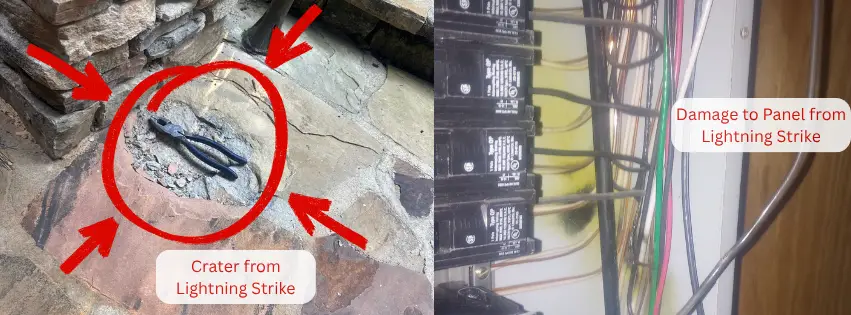
Lightning struck the stone walkway directly beside one of our customer’s homes, leaving a crater in the stone. The electrical energy traveled into the home’s electrical system and caused more than $3,000 in damage.
During our assessment, we found that the home’s grounding system had not been properly installed. While no grounding system can guarantee that a home will escape damage from a direct lightning strike, improper grounding can leave the electrical system more vulnerable when a surge occurs.
A ground rod is a metal rod driven into the earth and connected to the home’s electrical service. It is part of the grounding electrode system, which helps limit dangerous voltage caused by lightning, utility surges, or accidental contact with higher-voltage lines.
However, simply having a rod in the ground does not mean the home is properly grounded. The rod must be:
Grounding and bonding work together. Grounding connects the electrical system to the earth, while bonding connects conductive parts of the system so they remain at the same electrical potential and provide an effective path for fault current.
If either part is missing or incorrectly installed, breakers and other protective equipment may not operate as intended during certain electrical faults.
This is an important distinction: a ground rod by itself is not a lightning protection system.
A direct or nearby lightning strike can enter a home through electrical wiring, utility lines, communications cables, plumbing, or even the ground. Once inside, that energy can damage appliances, electronics, HVAC equipment, receptacles, switches, and wiring.
A more complete protection strategy may include:
Even these measures cannot promise complete protection from every direct strike, but they can help reduce risk and give damaging electrical energy safer paths to follow. The National Weather Service explains that a complete lightning protection system includes properly bonded components and surge protection for incoming power and communication lines. Learn more from the National Weather Service.
Grounding problems are not always visible to a homeowner. They may be found in older homes, properties that have undergone renovations, or electrical systems where additions were completed incorrectly.
Warning signs are not always obvious, which is why grounding should be evaluated by a qualified electrician. An assessment may be especially worthwhile if:
Do not remove clamps, alter grounding conductors, or attempt to install a ground rod yourself. Grounding and bonding are safety-critical parts of the electrical system and must be evaluated as a complete system.
If lightning strikes your home or the ground nearby, do not assume everything is safe simply because the power remains on. Electrical damage can be hidden.
Watch for burning odors, buzzing sounds, flickering lights, tripped breakers, damaged electronics, or outlets and switches that no longer work. If you see smoke or signs of fire, leave the home and call 911. Otherwise, have the electrical system professionally assessed before resetting breakers or continuing to use affected equipment.
This week’s Tuesday Tip is simple: a ground rod is only useful when it is properly installed and connected as part of a complete grounding and bonding system.
Kilowall Electric LLC can assess your home’s grounding, bonding, and surge protection and help identify problems before the next Western North Carolina thunderstorm puts the system to the test.